Please check footnotes for this post. / 3,818 words / Archival PDF download
Fëanor’s Fall as Read Through Augustinian Theology
Introduction
The story of Fëanor’s rebellion in The Silmarillion is a theologically resonant myth that dramatizes sin, exile, and hope for redemption—it is, of course, not a simple tale of tragedy & pride, seeing Tolkien’s background: he conceived of The Silmarillion as a form of “sub-created” myth, a “fundamentally religious and Catholic work” expressed through his imaginary cosmology.1 Both the Fall of Fëanor and the Noldor (to be referred to as ‘the Falls’) are, then, evidently not neutral narratives of Elvish disobedience but mythopoetic tellings of Catholicism: Tolkien evangelizes his audience in his presentation of the Falls as reskinned Catholic teachings, and interrogates the nature of freedom, distortion of Creation, and the consequences of prioritizing self-love over Divine participation.

The one of most import within this triad to me is the essence of self-love over Divine participation. Tolkien’s work is largely concerned with the evils of industrialization (as it is conceived within our society)—he wrote in a post-Enlightenment, post-industrial West where the cultural imagination (the Imagination) had become obsessively disenchanted; there were laments about Love without any understanding of Love, nor support of it,2 and thus the Imagination had become divorced of a sacramental world-view in which creation is ordered toward the Divine. The concern of amor sui, the love of Self, supplanting amor Dei, the love of God, for Tolkien went beyond a spiritual problem into a societal & cultural one. Fëanor’s inward turning, in his possessiveness of the Silmarils, and his refusal to yield to even the Valar, is a direct parallel to what Tolkien perceived as the modern elevation of individual autonomy, self-will, and a technological mastery over a receptive participation in the Divine order. Tolkien repeatedly lamented the modern world’s obsession with mechanization, domination, and control, all of which he perceived as spiritual sicknesses. In a 1944 letter to his son, he identified “the Machine” as “the desire for power, for making the will effective without effort and without regard to other wills.”3 This will-to-power, received externally as progress & genius, holds a clear connection to Fëanor’s tragedy. The sub-creator assumes the position of a false creator when he refuses to acknowledge the Divinity of his gift.
I will proceed through a soteriological reading of Fëanor’s Rebellion (seeing as I have been recently obsessed with eschatology) that situates the Rebellion within a Christian understanding that includes the traditional Augustinian and Irenaean perspectives on the Fall. Fëanor’s tragedy to me is not mere analogue of Edenic disobedience, but a dramatization of some metaphysical disorder Tolkien observed within his society, that of the mutation of the sub-creative4 brilliance into possessiveness, from desire to self-enclosure; as such, Fëanor’s Fall foregrounds a theology of grace and freedom in exile.
‘Sub-creative’ pride in Fëanor & Augustinian sin
Augustine’s account of sin as the ordo amoris5 offers to me a precise idea of understanding for the nature of Fëanor’s Fall. Fëanor’s Rebellion, as illustrated in the Silmarillion, is not of emergence from malice (or cruelty) but instead a misdirection of desirable sensibilities: love of beauty, creativity, and light—all of which become possessive and inward-turned, thus ultimately destructive. Augustine distinguishes for the Christian between amor Dei and amor sui. Amor sui becomes sinful when it seeks autonomy from the Order. Fëanor’s attachment to the Silmarils is a direct inspiration from the amor sui / Dei distinction of Augustine, in his turn from an act of sub-creative power to a refusal to participate in any order higher than the Self.
The making of the Silmarils is emblematic of Tolkien’s theology of sub-creation. Fëanor’s brilliance is not exactly condemned, but rather his Fall begins in his refusal to recognize the givenness of the Light that he captures as a gift. Fëanor does not create the light of the Two Trees, he receives it, but in his encasing of it and refusal to share it, Fëanor transforms gift into possession, much like the gift of Edenic dominion foretelling the betrayal of God’s idyll. The Silmarils become idols that are not evil in themselves but made the object of a Love that resists their original purpose. Augustine notes that sin does not consist in loving things per se, but in loving them “wrongly”—that is, to elevate above God, or treating them as ends in themselves. This wrong-love is the precise dynamic that gives understanding to the Augustinian cupiditas.6 It is not that Fëanor’s love for the Silmarils is false in itself, but that it has become isolated from some higher Divine reference point; in his Confessions, Augustine writes that sin consists in the clinging to created goods in a “perverse and unordered way.” Fëanor’s Rebellion is a dictum of such sin for he wrongly loves the Silmarils in that they become not only his possession, but his identity. The Silmarils are no longer beautiful because they reflect the Two Trees, nor the silver-blue light of Galadriel’s hair, but because they are Fëanor in themselves.
“For Fëanor began to love the Silmarils with a greedy love, and grudged the sight of them to all save to his father and his seven sons.” The Silmarillion, ‘Of the Silmarils and the Unrest of the Noldor‘
Unfortunately for Fëanor, this Augustinian-inspired idea of “loving wrongly” is only made more explicit when Fëanor refuses the Valar’s request to yield the Silmarils for the healing of the Two Trees. His refusal is not a reasoned disagreement, but as a defiant assertion of ownership. The Light is no longer a shared good of Eru Illúvatar, that who is Most High, but instead a personal and individual possession of Fëanor, his ‘capital.’ The mythopoetic retelling of the biblical Fall becomes clear: the movement of Fëanor from participation to possession, and from a receptive creativity held within sub-creation to a capitalistic domination. Tolkien’s own writings refer quite clearly to this Augustinian anthropology, of the Will being turned inwards into an overconsumption of amor sui. In the aforementioned 1944 letter, Tolkien’s identification of “the Machine” is the modern desire to impose the Will without regard to other wills—this is exactly Augustine’s idea of pride as the birth of sin. Further, Fëanor’s capitalistic domination of the Silmarils is an idolatry of his own sub-creative powers. Augustine warned that when the soul delights in its own powers rather than the Giver, it falls into superbia,7 the most basic but original of all sin. Thus, Tolkien’s portrayal of Fëanor aligns in an extremely satisfying way with Augustine’s theology that the will’s corruption begins not in action but in its focus, when the soul goes inwards rather than outward toward God (incurvatus in se).8
“Thus even while he [Fëanor] obeyed the Valar he did so only out of force… His heart was still bitter at the root.” The Silmarillion, ‘Of the Flight of the Noldor’
Fëanor’s posture of possessiveness is, in an Augustinian understanding, the corruption of caritas9 into cupiditas, which is the movement from the rightly ordered charitable love into the disordered and self-referential desire. For Augustine, caritas is the soul’s love that returns to God and orders all things in relation to Him, whilst cupiditas is a love turned towards the Self which seeks to enjoy created things apart from their Creator. It is an extension of amor sui, which is that simple love of the Self, that dictates a direct separation from the Order. Fëanor’s transformation of a poorly sub-created artifact, the Silmarils, into an absolute good for only himself (seeing his denial of Yavanna and all the Valar) shows what began in a noble love of caritas is consumed by the prideful superbia, which Augustine shows to be the beginning of all sin: a refusal to be subservient or subject to the Divine. Fëanor seeks some form of apotheosis through mastery of creation and invention. Pride is not just desire to be like God, but to replace God. This is why the Kinslayings, the doom of Mandos, and the long sundering of the Elves and the Valar are not dramatized tragedies, but the logical consequence of sin as a disordered love that disorders all relationships, including society and cosmology; Fëanor’s cause for the Fall is that of a metaphysical disorder that comes from his great theological error.
In effect, I see Tolkien’s intent with Fëanor’s Rebellion to be not a political or moral error first, but a theological one before all that; this understanding makes it expectantly clear for the reader as to the tragedies that emerge from the creation of the Silmarils, like the Kinslayings. Fëanor’s treatment of the sub-created as the final becomes bondage as it is a misplacement of the summum bonum, that is, Fëanor has broken the ordo amoris by enthroning a lesser good as the ultimate good of God. The aforementioned tragedies such as the Kinslaying, and other events such as the departure from Aman, and the rupture of communion, all come inevitably from the spiritual disorder that inhibits Fëanor’s wellbeing.
Exile as a theological consequence in Tolkien’s Catholic anthropology
We understand Fëanor’s Rebellion as an inward-turned theological error, that is, the rupture within the soul’s ordo amoris; then, the Fall of the Noldor must be understood not merely as divine punishment for Fëanor’s extrinsic actions, but as the manifestation of Fëanor’s internal metaphysical disorder. Indeed, Fëanor’s actions were facilitated by the grave theological error he committed (from superbia), and this error is private to Fëanor, but its real consequences are not. The exile of the Noldor (I shall refer to this as ‘the Exile’) is not the result of Divine punishment but instead is a metaphysical necessity that is founded within a theology of sin that purports Augustine’s privato boni: evil is not a substance but a lack, just as darkness is but the absence of light. This privation shows how the Rebellion displaces the Noldor from the Divine presence by consequence for its status as a cosmic disorder. Tolkien does not write of exile as an externally imposed decision, one which is political or strictly consequential, but instead as an ontological unbecoming. See: as the Elves abandon the ordo amoris and enthrone lesser goods in place of the Divine, both Eru Illúvatar and his Creations, the Valar, they naturally move away from the existence that pursues harmony with the Order. Aman, as the spiritual & geographic center of the Divine presence, becomes inaccessible not due to Eru Illúvatar’s displeasure at Fëanor’s actions, but because participation in the Good cannot coexist with self-deification. The Exile is a symbolic event that acts as a metaphysical truth, narrating the Catholic idea that pride severs not only relational ties (i.e., Fëanor and Fingolfin), but also the individual’s ability to inhabit the sacramental world in which all Creation is Ordered.
I feel as if this understanding of the Exile is given more significance if one considers Tolkien’s decision, as a writer, thereby Eru’s decision, to cast the journey of the Noldor not as heroic but as tragic & terribly regressive. The Exile is the movement of the soul from frui (enjoyment of God) to uti (use of God’s gifts), and finally to abusus (the disordering of both). Fëanor does not simply leave Aman, he rejects the very telos of Elvish being. In his doing so, we are presented with a great theological anthropology: that to reject the Divine origins of a gift is to remove oneself from their own nature. Fëanor’s identity as that sub-creator is utterly destroyed under the weight of his desire to be the Creator, and thus the Exile is a metaphysical rebellion with a real, actual ontological change within the souls of those who participated and did not reconcile. They lose the capacity to receive grace, and exile becomes a fitting iconographic state for their spiritual sicknesses. Aman is not taken from the Rebellious; they extricate themselves from it in a public dissent of Divine grace.
“Their hearts were still proud, for they had not in truth repented of their folly. And as they turned back they beheld afar off the light of Aman, like a cloud upon the horizon of the Sea, and it was very fair; and the Elves murmured, for they longed to return. But they dared not turn back, and they came never again into the west.” The Silmarillion, ‘Of the Flight of the Noldor’
Tolkien’s decision to write the Rebellion as binding through oath as opposed to wild revolt shows this Augustinian influence in the reading of exile as a form of spiritual slavery. Sin, whilst appearing as freedom, is in fact the soul’s very bondage to its own sicknesses and disordered desires, of which will only result in suffering for the individual. The Oath of Fëanor is not just a narrative device—though it is a good one at that—but it is the display of the will’s self-imposed captivity in a misgiving as to what is freedom and what is imprisonment. The Oath becomes, in some strange way, a spiritual and metaphysical structure that ensnares not only Fëanor and his seven sons, but also the future generations who are bound by the curse of their father’s cupiditas. This is not a ‘moralization,’ but rather, Tolkien is theologizing: he presents this Catholic-Augustinian account of the will as darkened by sin. The Oath does not strengthen the Noldor in their faux autonomy, but it entraps them within the limited space of their own wrong-loves; Tolkien’s continued return to this theme throughout the entirety of The Silmarillion shows his conviction that sin has great temporal & generational consequences, outside of eschatological ones. Exile is an entire condition for the state of the Noldor and Fëanor’s Rebellion was not a single act; it was the soul’s bondage to itself, of those that followed Fëanor, that is inherited and reenacted consistently for the will is no longer capable of ordering itself toward the Good. The Oath of Fëanor is the display of his loss for capacity of ordo amoris; for Tolkien, in his Catholicism, it was an oath that should have never been taken, as it abandons the very telos of Eru Illúvatar’s Creation! (cf. James 5:12 NRSVUE)
The Oath of Feanor
Be he foe or friend, be he foul or clean,
brood of Morgoth or bright Vala,
Elda or Maia or Aftercomer,
Man yet unborn upon Middle-earth,
neither law, nor love, nor league of swords,
dread nor danger, not Doom itself,
shall defend him from Fëanor, and Fëanor’s kin,
whoso hideth or hoardeth, or in hand taketh,
finding keepeth or afar casteth
a Silmaril. This swear we all:
death we will deal him ere Day’s ending,
woe unto world’s end! Our word hear thou,
Eru Allfather! To the everlasting
Darkness doom us if our deed faileth.
On the holy mountain hear in witness
and our vow remember, Manwë and Varda!10

This is why Tolkien never fully ‘restores’ Aman to the Noldor in any sense, even to the most faithful like Galadriel, for the theological structure of The Silmarillion operates within Tolkien’s Augustinian idea that exile must be redeemed not by any return to prior states, but by reformation through the acceptance of grace. In a biblical sense, humanity is incapable of returning to an Edenic state; rather, humanity must only pass through the redemptive suffering of history as to unite with the Thomistic beatific vision. The same goes with the Elves—Tolkien creates no ‘undoing’ of Fëanor’s Rebellion, not because of any disparity for grace, but because as a Catholic, he fundamentally aligns with salvation history. The Noldor’s communion is lost, and they must await alongside all the eschaton, when Arda Marred is healed. Through the transformative experience of suffering, the Noldor become instruments within a plan of future redemption that is unique in knowledge to Eru Illúvatar, much like the classical Christian God. The fall into sin results in exile from God’s immediate presence, but this exile becomes a possibility of participation in the Divine again, and ground upon which grace may be received again.
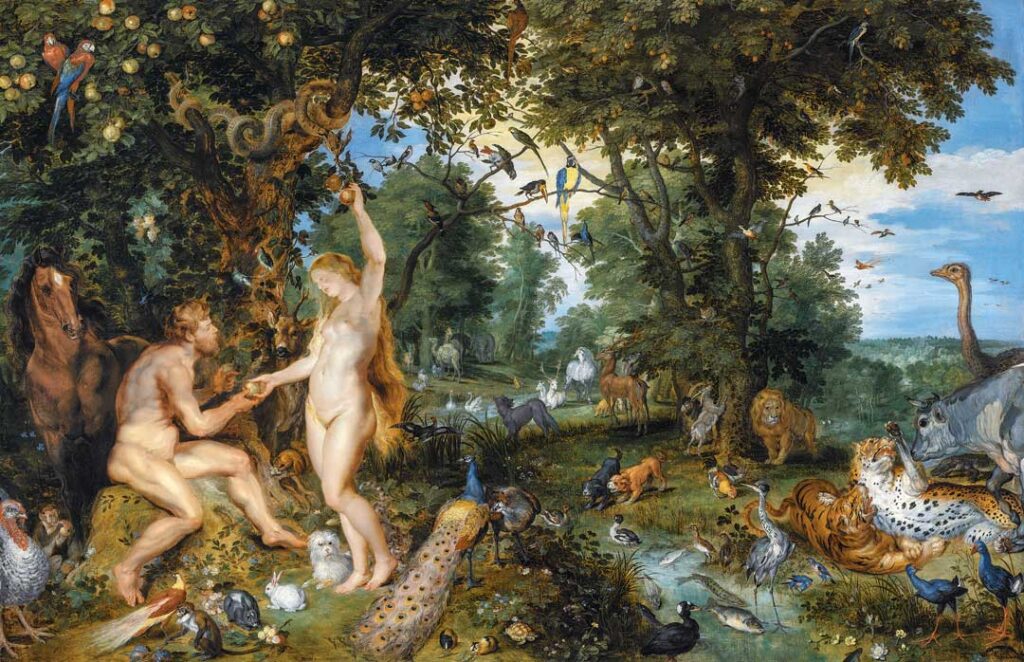
The Garden of Eden with the Fall of Man
The cultural Imagination and the Modern Fall by amor sui
We understand the ontology of Fëanor’s Rebellion and his turn into a radical amor sui that establishes a coup against the Divine. But what is also of interest is Tolkien’s possible inspiration from the death of wonder within the modern world. The inversion for Fëanor’s inward-turning corresponds to the shift of the Imagination. The Enlightenment, with its strong focus on self-legislation, autonomy, and Western empiricism, to me, redefined freedom as independence from tradition, nature, and divine authority. The ideal Self is no longer one that participates actively in the Good but a sovereign subject whose legitimacy is derived exclusively from amor sui. Thus, freedom becomes but a capacity for self-direction, and a necessity that is disjoined from any teleological orientation towards the Good & the Divine. That Augustinian liberty of right-loves collapses under a conception of freedom as mere non-interference.
One of the most tragic casualties of such a shift is the death of wonder, which is understood not as naïve awe nor sentimentality but as a rational and spiritual posture of receptivity assumed by one toward the gratuitous nature of Being. In the Christian tradition inspired by Augustinian, Boethian, and Thomistic metaphysics, Creation is intelligible via analogy (natural theology) and participation. Created realities serve as theological pointers in an almost Barthian sense, in that they point beyond themselves towards the Divine. Wonder, for the Christian, is the natural response of the conscious intellect when it is confronted with the sublimity and mystery of the Divine’s Gift. The Modern Fall—that disenchantment rationalized by those such as Weber—is what marks the collapse of this metaphysical posture to me. Reality is no longer interpreted as a gift universally in a post-Industrial world and becomes instead a resource to be manipulated for some other gain. This causes all to live in a flattened materialism. The analogical structure is replaced by rationality that leaves no room for imagination nor inspiration. The power of language is lost as it becomes a tool for control as opposed to communion, as ironic as such a saying may be considering the state of Doom-fear in the Middle Ages.
“I am a philologist and all my work is philological. The invention of languages is the foundation. The ‘stories’ were made rather to provide a world for the languages than the reverse. To me a name comes first and the story follows. I should have preferred to write in ‘Elvish’.” Tolkien, Letter 8911
Speaking independently, it is clear that the greedy malaise that broadly affected modern populations as observed by Tolkien is what inspired him for Fëanor’s Rebellion; it goes beyond an Edenic analogy. See: in On Fairy-Stories, Tolkien characterizes fantasy as offering “recovery” and a “regaining of a clear view.” This ‘clear view’ is the realignment of love away from amor sui and towards Dei, and reinstating the wonderous worldview we had before industrialization brought about the death of the arts. Fëanor’s own amor sui reflects the dastardly impacts of superbia, yes, but also the broader desacralization of the West. I see it clearly in the character of Fëanor, when we first meet him as “the mightiest in skill of word and hand,” yet his possession of the Divine itself turns him into this caricature of modernity, wherein he “seldom remembered now that the light within the Silmarils was not his own.” We have moved from a culture of reverence to acquisition, and Tolkien laments this in Fëanor’s Rebellion, his Fall, and the Fall of the Noldor.
Conclusion
I will not tarry and repeat myself. It is only important to remember that Fëanor’s Rebellion, as viewed through a Catholic-Augustinian lens, but more greatly a Christian lens, is a ‘theodramatic’ meditation on the nature of love, freedom, and theological error. It reflects Tolkien’s observations in modern society, with the degradation of the Imagination; it serves as more than a historiographical retelling—instead, it is the showcase of a spiritual & metaphysical sickness manifest within Fëanor as he succumbs to superbia, and his caritas is corrupted into cupiditas. Fëanor’s Rebellion is most interesting, especially his Oath, for it is almost like an extension of the biblical story of Eden.
Part of a larger thread: Tolkien Masterlist
Footnotes
- J.R.R. Tolkien, The Letters of J.R.R. Tolkien, ed. Humphrey Carpenter (London: HarperCollins, 1995), Letter 142. ↩︎
- I will not expand on this, but I would refer you to John Boswell and his writings on Love in Modern Europe, specifically in contrast to Premodern, i.e., his Same-Sex Unions in Premodern Europe is excellent. ↩︎
- Ibid., Letter 131. ↩︎
- When I refer to sub-creation, I refer to Tolkien’s idea: that sub-creation is the creaturely act of making within the bounds of Divine Creation. In his 1939 lecture On Fairy-Stories, Tolkien defines sub-creation as the human capacity to fashion those “Secondary Worlds,” of which reflect or participate in the truth of the Primary World of God. Sub-creation is not an exact autonomous invention but an act of response to existing within God’s creation. It is a respect of imitation of the Creator, and it is an act of praise or God-worship. When misdirected, however, as Fëanor’s is, it risks becoming idolatrous and heretical. ↩︎
- The proper ordering of one’s loves. God is loved above all else and all other things are loved in relation to Him. Sin comes from loving X disproportionately and in a way that displaces God from the highest place of the soul’s affections. ↩︎
- Cupiditas stands in contrast to caritas. It is the disordered and inward-turning desire that seeks to possess or enjoy things apart from God. It often denotes the ‘root impulse’ of sin. ↩︎
- The foundational sin of an arrogant self-exaltation that seeks complete and utter autonomy from God. It is the spiritual condition wherein the soul delights in its own power rather than that which is Given. Superbia is the source of all other vices. ↩︎
- In fact, not originally an Augustinian idea, rather later seen by theologians like Martin Luther, but it (ironically) expresses an Augustinian idea, that sin consists in the turning of the soul inward, away from God and neighbor, into a self-enclosed posture of pride and amor sui. ↩︎
- The rightly ordered love that holds a desire for union with God and acts in accordance with the Divine Will. It is the soul’s outward movement toward the eternal Good. ↩︎
- The Annals of Aman, 134 (Morgoth’s Ring, p. 112) ↩︎
- Letter 89, The Letters of J.R.R. Tolkien, edited by Humphrey Carpenter with Christopher Tolkien (1981), p. 211. ↩︎
Primary references
- Tolkien, J.R.R. The Silmarillion. Edited by Christopher Tolkien, HarperCollins, 1977.
- Tolkien, J.R.R. The Letters of J.R.R. Tolkien. Edited by Humphrey Carpenter, with Christopher Tolkien, Houghton Mifflin, 1981. [Especially Letter 131 (to Milton Waldman) and Letter 153 (to Christopher Tolkien)]
- Augustine of Hippo. Confessions. Translated by Henry Chadwick, Oxford University Press, 1991.
- Augustine of Hippo. City of God. Translated by Henry Bettenson, Penguin Classics, 2003. [Books XII–XIV are particularly relevant for original sin and the ordo amoris]
Secondary references (Tolkien & theology)
- Kilby, Clyde S. Tolkien and the Silmarillion. Harold Shaw Publishers, 1976. [Very accessible theological reflection on the creation & cosmology of Tolkien’s myths]
- Pearce, Joseph. Tolkien: Man and Myth. HarperCollins, 1998. [Excellent reference for the impact of Tolkien’s Catholic worldview and its impact on The Silmarillion]
- Wood, Ralph C. The Gospel According to Tolkien: Visions of the Kingdom in Middle-earth. Westminster John Knox Press, 2003.
- Burns, Marjorie. “King Sheave and the Lost Road to Fairyland.” In J.R.R. Tolkien and His Literary Resonances: Views of Middle-earth, edited by George Clark and Daniel Timmons, Greenwood Press, 2000.
- Shippey, Tom. The Road to Middle-earth. Houghton Mifflin, 2003. [Great for understanding Tolkien’s mythopoeic technique and also his Catholicism]
Secondary references (Augustine)
- Matthews, Gareth B. Augustine. Blackwell, 2005.
- O’Daly, Gerard. Augustine’s Philosophy of Mind. University of California Press, 1987.
- MacIntyre, Alasdair. Three Rival Versions of Moral Enquiry. University of Notre Dame Press, 1990.
- Balthasar, Hans Urs von. The Glory of the Lord: A Theological Aesthetics, Vol. I. T&T Clark, 198
Further related reading
- Heidegger, Martin. The Question Concerning Technology, in Basic Writings, edited by David Farrell Krell, Harper Perennial, 2008. [Especially relevant in contextualizing “the Machine”]
- Pieper, Josef. Leisure: The Basis of Culture. Ignatius Press, 2009.