
Melkor’s Discord in the Ainulindalë
In the Beginning, there was Sound. There were not yet stars nor sea, nor light nor shape, but only the radiant thought of Eru Ilúvatar, the One, heard through song. This is the myth that Tolkien places at the root of his legendarium, the Ainulindalë of the Silmarillion: the Music of the Ainur.
The world is not spoken into being, as seen in early biblical genesis stories (Psalm 33:9), but sung. Yet even here, before Time is counted or matter is conceived, there is already discord and blasphemous ambition amongst the Order of the One. It arises not from chaos or accident, but from the mightiest and most powerful of the Ainur: Melkor.
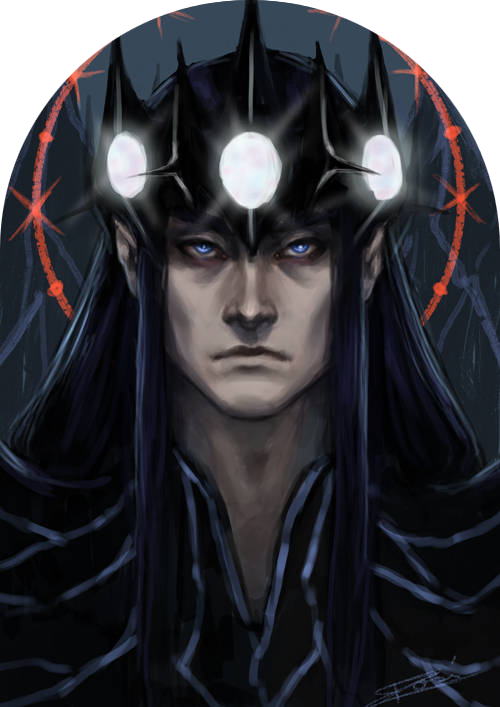
The Ainulindalë is Tolkien’s genesis myth and his most elegant metaphysical statement of a cosmogony sung into being, where creation is both harmony and disharmony alike. “Among the Ainur, he [Melkor] had been given the greatest gifts of power and knowledge,” and he had “a share in all the gifts of his brethren” (Silmarillion, p. 15). This makes him, in some sense, the most complete mind in the initial created Order of Ilúvatar. Melkor’s potency is neither incidental nor ornamental but rather is entirely integral to the structure of the Music itself, and it is precisely this comprehensiveness which is gifted to him that seeds his deviation from the orderly Music of the Ainur. The knowledge of the other Ainur is delimited and channeled into particular themes as commanded by the Will of Ilúvatar, but Melkor’s exposure to a greater totality of the divine thought gives rise within him for a desire to surpass, create, and ultimately originate.
“He had often gone alone into the void places, seeking the Imperishable Flame, but he found it not; for it is with Ilúvatar. But being alone, he had begun to conceive thoughts of his own unlike those of his brethren.” The Silmarillion, p. 16
The Music of the Ainur
To understand the brevity of Melkor’s Discord, as I will call it, we need to understand what the Music is in its entirety. This will be discussed in detail in other posts, alongside the nature of Eru Ilúvatar and his Order, but what must be understood for Melkor’s Discord is how the Music is the design for the world that will come. The Music is not merely symbolic or decorative, but the actual and real detailing of Eru’s Order and Will for the world. Each of the Ainur contributes to the unfolding of a theme revealed to them by Eru Ilúvatar in accordance with their specific gifts and understanding.
“[…] each comprehended only that part of the mind of Ilúvatar from which he came.” The Silmarillion, p. 15.
So, their Music, although individual, is allowed with the intent to form a greater unity that ultimately glorifies the great symphony of Eru Ilúvatar. The Ainur do not exactly invent freely or originate from themselves; they only elaborate upon the theme already beatified to them by Eru Ilúvatar. The Music is the act of the shaping of creation, which is already determined by Eru’s Order—some sort of ‘first articulation,’ as I like to understand it, which Eru Ilúvatar later makes real through the word Eä.
What this reveals to us in the importance of Melkor’s Discord is that there is one key principle in Tolkien’s cosmology: that the act of creation involves cooperation, not competition, with the divine will. As Melkor introduces his chaos into the Music, he is not offering a rival creation or a truly new idea as he seems to think he is, but instead he is twisting what already exists and claiming ownership over a design that was meant to be shared amongst the Ainur. For as the Ainur sing in harmony, Melkor interrupts with a discourteous tune. In their confusion, and their lack of ambitious thinking, unlike Melkor’s, the Ainur around Melkor begin to conform to his Discord, and Eru Ilúvatar’s countenance grew stern and terrible.
The Intent of Melkor
But why would Melkor even seek deviation? We understand very early on that Melkor was dissatisfied with merely participating, and that he wished to have creation of his own to dominate and impose order upon—that he is not merely destructive—but why did Melkor’s ambition drive him to believe that he would be unable to do so within Eru Ilúvatar’s song?
Melkor’s Discord comes not from chaos nor hatred, but his desire to go beyond the role of participant. He refuses to participate in Arda because of its birth within Eru Ilúvatar, and if the source is not Melkor, then Melkor sees participation as restrictive. Melkor’s desire for the Flame Imperishable reflects this, as it is not simply a lust for power, but a misdirected yearning for creation and authorship that motivates Melkor’s wish to give independent life to his own ideas, to be more than an instrument in the design of Eru Ilúvatar. But even with this mindset, Melkor’s motivation is not necessarily malicious in intent from the outset, for even though Eru Ilúvatar reprimands Melkor, and grows terribly angry, he does not punish nor revoke any gifts bestowed upon Melkor in his power or intelligence. Rather, Melkor’s Discord is a profound confusion; Melkor cannot understand that within the world of Ilúvatar, creation is always received and never possessed by any other than the One. The Flame Imperishable, the very power to make real, cannot be seized by a will for domination alone as it is not a substance but an attribute of Eru Ilúvatar’s very being.
“He had often gone alone into the void places, seeking the Imperishable Flame, but he found it not; for it is with Ilúvatar.” The Silmarillion, p. 16.
Melkor seeking the Flame in the Void tells us something crucial about his character. Melkor’s idea to seek the Flame in the Void, which is in isolation, and in the place where nothing responds to him, is because he truly believes that freedom and creativity must lie in separation and in the unbounded realm of self-will. Yet, he finds nothing there, for the Flame is with Ilúvatar. Melkor’s Discord arises from his wish to create without communion with others in order to make something that is entirely his own—and we see this later in The Silmarillion with his creation of, for example, the Orcs—but Melkor is incapable of doing so, for creation requires a participation in the divine thought.
Even before his open Discord in the Music of the Ainur, Melkor’s creativity had turned inward and closed off from the shared song of the Ainur created alongside him. I feel that Melkor believes his difference entitles him to dominion, and that his previous confusion also meddles originality with isolation; he fails to see that difference alone is not what makes one a creator, but instead love, harmony, and the willingness to let being be constitutes a creator. And so, in misunderstanding creation, Melkor misunderstands Eru Ilúvatar himself.
Melkor’s Discord is Prophetic
Melkor’s Discord is an extremely important event in The Silmarillion, and it creates our expectation for Melkor’s acts in the subsequent eons; of course, we already understand Melkor to be a Satanic figure with his rebellion in the early stages of creation, but Melkor is more personal than the biblical Satan. Whereas Satan is wrathful, prideful, rightly deemed as ‘demonic,’ and associated with all the poorness of the world, we see a genuine intent within Melkor that is not simply prideful, nor wrathful, though he can be both: Melkor has a genuine want and intent for freedom and creation, and his hamartia is that, in his greatness, he will never be satisfied with sub-creation in the song of Ilúvatar. His Discord becomes the pattern of his entire being, for what one sings reveals what one is. When Melkor weaves his will into the Music with a “loud and vain voice,” it is not a simple moment of rebellion, but also a mirror of what he shall become—one that is trapped within the echo of his own voice, and never content with what is around him.
The final word that Eru Ilúvatar bestows upon him after the event of his cacophony is “and thou, Melkor, shalt see…”–this becomes both judgement and prophecy for Melkor. He will see, in the end, that all of his ambition and efforts leads not to freedom, and freedom to create (the pretense that Melkor is under), but instead to a cage of his own making. Every act of will becomes a narrowing compulsion that brings Melkor closer to his perception of Eru’s Order being imprisonment; every creation becomes a parody of something unachievable for Melkor. Even with the Silmarils, made not by Melkor, will become the focus of his lust, because Melkor cannot bear that beauty should exist outside of him or created by any other hand. Melkor’s Discord does not end with the Music of the Ainur, but it merely extends itself into the world upon its creation.
Part of a larger thread: Tolkien Masterlist