Reading length: 1676 words / Archival PDF download
Introduction
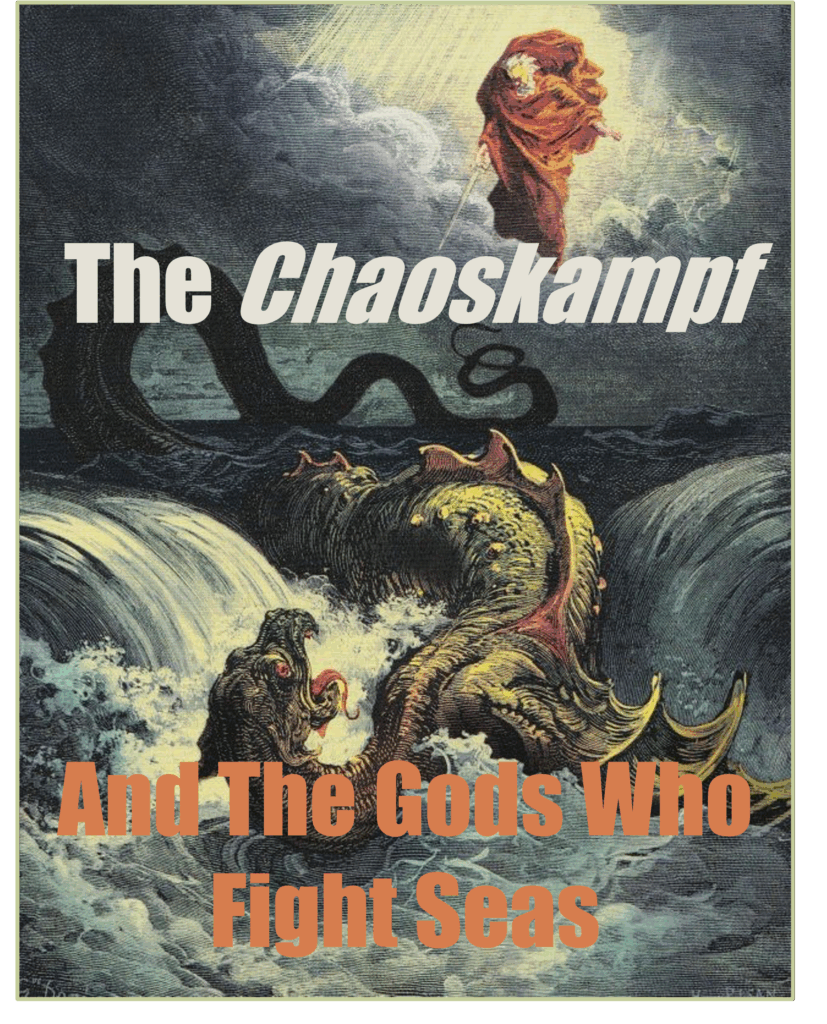
There are few images more enduring, or more theologically fertile, than that of a god confronting the sea. Across the mythologies of the ancient Near East, from the Ugarits of Canaan to Babylon, there is a consistent drama of a divine hero facing the deep; subduing the monstrous forces of primordial chaos, and, in doing so, bringing the world into being. In all of these “Chaoskampf” myths, the sea is not just thematic—it is a symbol of the unformed, the undifferentiated, and the threatening non-order that resists creation. This is what we understand when we talk of the Chaoskampf (which is, literally, “battle against chaos”).
I have been exploring the biblical links between Old and New Testament myths (Genesis 1, Isaiah, Psalms) and the Canaanite Chaoskampf myth—specifically of Baal and the sea-god Yam—which prompted me into reading Smith’s The Origins of Biblical Monotheism. What struck me about this connection was its strange persistence. For a tradition that becomes so fiercely monotheistic in its changing history, the Hebrew Bible preserves, almost stubbornly, the imagery of cosmic combat. It is easy to simply treat these as vestigial myths or patterns, those primitive residues that monotheism later refined away, yet the more I read, I found I was increasingly less inclined to do so.
Truly, this narrative appears in several ancient contexts: in the mentioned Ugaritic tablets, the storm-god Baal Hadad defeats Yam, the sea; in the Babylonian Enuma Elish, Marduk slays Tiamat, the chaos-dragon; and in the Hebrew Bible, we have YHWH subduing Rahab and Leviathan, YHWH dividing the sea, and YHWH rebuking the deep. We can observe a shared cosmological concern between these cultures, in that order must be won from chaos and further maintained against its return. And so, the observance of the Chaoskampf within the biblical canon should be read as a continuing hermeneutic structure that only further depends on our understanding of the Bible as a religious and historical text.
“He rebuked the Red Sea, and it became dry; he led them through the deep as through a desert.”
Psalm 106:9
Chaoskampf in the Hebrew Bible
The presence of the Chaoskampf appears in several strata of the Hebrew Bible, but never as a fully developed myth. Rather, the imagery shows itself in prophetic or poetic texts as a means of expressing the sovereign and creative powers of YHWH as the one true God. The clearest instances in Scripture are in the Psalms and in the exilic prophets, where the divine mastery over the sea becomes a recurring theological motif.
In Psalm 74:13-14, we have the most explicit parallel between YHWH and the Chaoskampf.
“You divided the sea by your might; you broke the heads of the dragons in the waters. You crushed the heads of Leviathan.” NRSVUE
In the Canaanite Chaoskampf myths, there is a distinctness within the semantic language used, as it often reflects combat and physical battle. This is maintained within this verse, with Leviathan corresponding to Lotan of Ugaritic tradition. However, the theological implication of this altercation is changed. The victory does not establish YHWH’s kingship within a pantheon as the previous myths did, but instead, it reveals the absolute sovereignty of a single God over creation. This imagery recurs in Psalm 89:9-10, where YHWH “rules the raging of the sea” and “crushes Rahab like a carcass.”
In Job 26:12-13, YHWH “stills the sea with his power” and “shatters Rahab by his understanding.” In here, the divergence from the martial or combative nature of the Chaoskampf can be pointed out more clearly; divine wisdom replaces the traditional Near Eastern ideas of domination being violence—intellectualism becomes the means of ordering chaos. Isaiah 51:9-10 similarly invokes the defeat of Rahab and the drying of the seas as a paradigm for Israel’s redemption from exile. The “chaos monster” becomes a theological symbol; the same God who subdued primordial waters will restore his people. In every case, the mythic imagery of the Chaoskampf is maintained but transposed into new contexts.
Theological transformation of the Chaoskampf
The transposition of the Chaoskampf motif from the polytheistic combat-focused narrative to monotheistic theology shows something more than a simple ‘literary’ adaptation; it constitutes a redefinition of divine ontology, rather. In the Hebrew reinterpretation, mythic imagery is retained, but its cosmological function is subsumed within a theological one. The classic archetype of the chaos monster is not eliminated as a narrative element but recontextualised as a symbol of created contingency: that which exists only in dependence upon divine order. As a result of this, we get a conceptual rather than physical conflict. The sea and its monsters signify the ever-present potentiality for disorder within a created but finite cosmos.
But in this move, there is a decisive alteration in the logic of power. In both the Ugaritic and Babylonian cosmogonies, divine kingship is established through conflict; the god becomes sovereign by defeating a rival. In the Hebrew texts, however, sovereignty precedes combat. YHWH’s kingship is not the consequence of victory but its precondition. The destruction of Leviathan or Rahab is not a means by which divine authority is secured, but its expression and portrayal to the receiver. This is where the polemical force of these passages becomes abundantly clear to us. The mythic language of the Hebrew Chaoskampf myths is used to assert that only YHWH, alone, has the creative power and agency that was previously shared among many deities.
This change in theology also impacts the metaphysics of creation itself, we could argue. Whereas the Babylonian Enuma Elish constructs the cosmos from the body of Tiamat, the Hebrew tradition begins with an already-distinct Creator, God, who brings order ex nihilo. Or, more precisely (and controversially), ex chaos. I do not claim to undermine the doctrine of Creatio ex nihilo, I am only assessing its potential links and influences as being somewhat derivative from the Chaoskampf.
Chaos becomes, in some sense, not a rival “being” but a structural possibility inherent in the world’s finitude; a condition perpetually restrained by divine will, and a condition with some necessary existence. The persistence of chaos imagery across the Psalms and Prophets shows to me an understanding of creation as a continuous act of preservation. We could even say that YHWH’s creative word must be repeatedly asserted against that force of dissolution.
From a theological-philosophical perspective, the Hebrew interpretation of the Chaoskampf also signposts an early convergence between cosmology and theodicy. These mythic figures such as the sea, Rahab, and Leviathan are not simply “rival deities” but instead, they become symbols of creation’s inherent instability—the continual possibility of disorder within the finite world. Indeed, they are not moral agents, but simply expressions of the religious view’s idea that the world depends on divine order. In later Jewish and Christian interpretation, this imagery is also further interiorised. The divine struggle is not read as mythic history but as a permanent aspect of the relationship between Creator and creation. The Chaoskampf because a beautifully theological framework, as opposed to some simple narrative, an almost conceptual grammar through which doctrines of divine sovereignty, creation, and providence can be found.
The Christological fulfilment of the Chaoskampf
In the Synoptic Gospels, the Chaoskampf is not abolished but reframed within the figure of Jesus. When Jesus rebukes the storm on the Sea of Galilee – “He woke up and rebuked the wind, and said to the sea, ‘Peace! Be still!’ Then the wind ceased, and there was a dead calm” (Mark 4:39) – there is a recollection of the rebuke from YHWH’s confrontation with the sea in the Hebrew Bible. In Psalm 106:9, God “rebuked the Red Sea, and it became dry”; and in Nahum 1:4, “He rebukes the sea and makes it dry.” It is like a formula, in that ‘rebuke’ (gāʿar) signals the single divine assertion of order over chaos. In the context of the Gospels, Jesus’ rebuke is theophanic; an implicit claim to the creative and powerful authority of God.
When we approach Christ’s rebuke in Mark with this idea in mind, we can distinguish two operative levels within the verse. First, it is a miracle story that shows Jesus’ authority over nature. This is the superficial operative level. On a deeper level, it is an eschatological re-enactment of the Chaoskampf in a non-mythic idiom. If you will. The raging sea is the symbol of creation’s disorder, and Jesus’ declaration is the principle of its restoration, a structure I have outlined many times beforehand.
With this similarity, we have a supportive basis for Christology in that he mirrors the divine powers of the Hebrew YHWH over chaos. Further, the eschatological denotations of Jesus’ Chaoskampf reappears in Revelation 21:1, with: “Then I saw a new heaven and a new earth; for the first heaven and the first earth had passed away, and the sea was no more.” The “sea” is the primordial disorder, and its disappearance shows us the very completion of the divine ordering that began in Genesis and was further enacted in Christ. So, the crucifixion and Resurrection can also be read in this continuum: the Cross is the descent into the world of chaos and death, and the Resurrection as the definitive Chaoskampf overcoming of that world. In this sense, Christ’s victory in Resurrection is a redefinition of the Chaoskampf myth for the Christian tradition at the level of ontology and soteriology. The subdued “enemies” are no longer the chaos monsters, but the extremely relevant Christian metaphysical consequences of sin and morality. We no longer have the sword, but the Logos; and no longer do we have domination, but “self-emptying” (Philippians 2:6-11).
Conclusion
The Chaoskampf myth is a Christian mode of theological imagination—a way in which we can read the world as a site of divine order and its confrontation of disorder. In the Hebrew tradition, it narrates creation as conflict; in the New Testament, it becomes the method of Christological reconciliation that functions as the basis for all Christian tenements. What is important about the Chaoskampf is that we do not leave it in the distant history of the Near East but understand it to be a hermeneutic through which we can better understand Christian theology and the Bible itself.
References
- The Holy Bible: New Revised Standard Version, Updated Edition (NRSVue). National Council of Churches of Christ, 2021.
- Day, J. (1985). God’s Conflict with the Dragon and the Sea: Echoes of a Canaanite Myth in the Old Testament. Cambridge University Press.
- Levenson, J. D. (1988). Creation and the Persistence of Evil: The Jewish Drama of Divine Omnipotence. Princeton University Press.
- Smith, M. S. (2001). The Origins of Biblical Monotheism: Israel’s Polytheistic Background and the Ugaritic Texts. Oxford University Press.
- Wyatt, N. (2001). Space and Time in the Religious Life of the Near East. Sheffield Academic Press.
- Ricoeur, P. (1975). Biblical Hermeneutics. Semeia, 4, 27–148.
- Beale, G. K. (1999). The Book of Revelation: A Commentary on the Greek Text. Eerdmans.
- Bauckham, R. (1993). The Theology of the Book of Revelation. Cambridge University Press.
- Wright, N. T. (1992). The New Testament and the People of God. SPCK.
- Middleton, J. R. (2005). The Liberating Image: The Imago Dei in Genesis 1. Brazos Press.