Reading length: 1900 words / Archival PDF download
Introduction
E.J. Lowe’s four-category ontology (‘The Four-Category Ontology’) is, for all purposes, a systematic reworking of the distinctions Aristotle sets out in Book I of The Organon, Categories. In Categories 1 (1a1-1a16), Aristotle introduces three ways terms can be related: ὁμώνυμα (homōnyma, homonyms/univocal), συνώνυμα (synōnyma, synonyms/equivocal), and παρώνυμα (parōnyma, derivatives). In Categories 2, he distinguishes between what is “said of a subject” (καθ’ ὑποκειμένου) and what is “in a subject” (ἐν ὑποκειμένῳ). These two distinctions structure the later claim in 2a11-19 that substance, ousia (οὐσία), is primary, since all other entities are either said of or in substances. For the purpose of simplicity, I will now only refer to anglicised or English terms of Aristotle’s distinctions, since I, quite frankly, have no interest in the semantics of the original Greek (really, philology goes over my head, which is ironic as a Tolkienist).

In Lowe’s ontology, we can see that he systematises this original material. He takes Aristotle’s two clear contrasts of (i) substance v. non-substance, (ii) universal v. particular and categorises them into four irreducible ontological categories: substantial universals, substantial particulars, non-substantial universals, and non-substantial particulars.
Preliminary to the Categories
Categories begins from distinctions about language, but Aristotle treats them as indicative of distinctions in being. In Chapter 1 (1a1-1a16), Aristotle differentiates between the aforementioned homonymous, synonymous, and paronymous predication; homonymous is equivocal, in which they share the same ‘word’ but not the same ‘kind’ of being; synonymous is univocal, where some things share the same ‘word’ and ‘kind’ of being; paronymous is derivative, in which some things are named from other things, in that their meaning depends on that derivation/origin. These distinctions prepare a footing for the central contrast in Chapter 2 (1a20-2a4) between what is said of a subject and what is in a subject. A universal kind (thing) such as “man” is said of a particular like Socrates; an attribute such as “white” is in a subject like Socrates.
Aristotle identifies substances as those things that are neither said of nor in a subject (2a11-19). Socrates and Bucephalus examples of this, as they are individual existents that are not predicated of other things and do not inhere in them. These he calls “primary substances.” Alongside the primary substances, he recognises “secondary substances” which are the species and genera to which the primary substances belong, such as “man” and “animal.” These are said of subjects but not in them (2a14-19).
We can see, then, that Aristotle’s category of substances is, on one hand of individual substances, independent particulars that are not “said of” or “in” a subject (like Bucephalus). On the other hand, there are universal kinds, which are the species and genera. Aristotle instantiates the particulars as primary, since the kinds depend on them for their own instantiation, but both are admitted into the class of substances.
By contrast, accidents such as “white” or “grammatical” never participate in this independence. They are always said “in” a subject (2a33-2b6). Yet here too Aristotle does recognise a universal/particular division. “White” can be said of many different things, but the specific whiteness of Socrates is not said of anything else. The same principle holds for attributes such as “knowledge of grammar”: There is the universal property and its particular instances in different souls or persons.1
Lowe’s conceptual commitments
A little context is needed to understand Lowe’s intention with his four-category ontology beyond the philosophy itself. This is my understanding of Lowe’s commitments and how they influence his decisions with his ontology:
i) Lowe adopts a realist stance in that substantial particulars, substantial universals, non-substantial universals, and non-substantial particulars all exist independently of our conceptual schemes. For example, kinds such as “man” are real features of the world, not just linguistic conveniences; properties like whiteness exist as repeatable universals; individual substances instantiate these kinds; and individual property-instances exist as tropes.
ii) Lowe’s motivation is of a concern for explanatory completeness and ontological non-reductionism. In Lowe’s view, earlier ontologies either collapsed categories or failed to recognise essential distinctions. For instance, collapsing the category of properties into universals without acknowledging their particularised instances obscures how attributes relate to substances entirely. Likewise, neglecting distinctions between substantial universals and particulars puts at risk the explanatory connection between kinds and their instances. By coherently forming these four irreducible categories for an ontology, Lowe ensures that the system is capable of accommodating all basic entities needed for predication, classification, and explanation of any sort.
iii) Lowe places his system in a continuity with Aristotle whilst also responding to contemporary analytic debates or arguments. His formalisation makes explicit distinctions that Aristotle’s work only hinted at, if that, such as the separate ontological status of non-substantial particulars. At the same time, Lowe’s ontology addresses questions familiar to modern metaphysicians, such as the ontological status of tropes, the role of kinds in structuring particulars, and the relationship between substance and property. So, in this sense, Lowe’s four-category ontology is both a historical continuation but also something moderately new.
Overview of Lowe’s four-category ontology
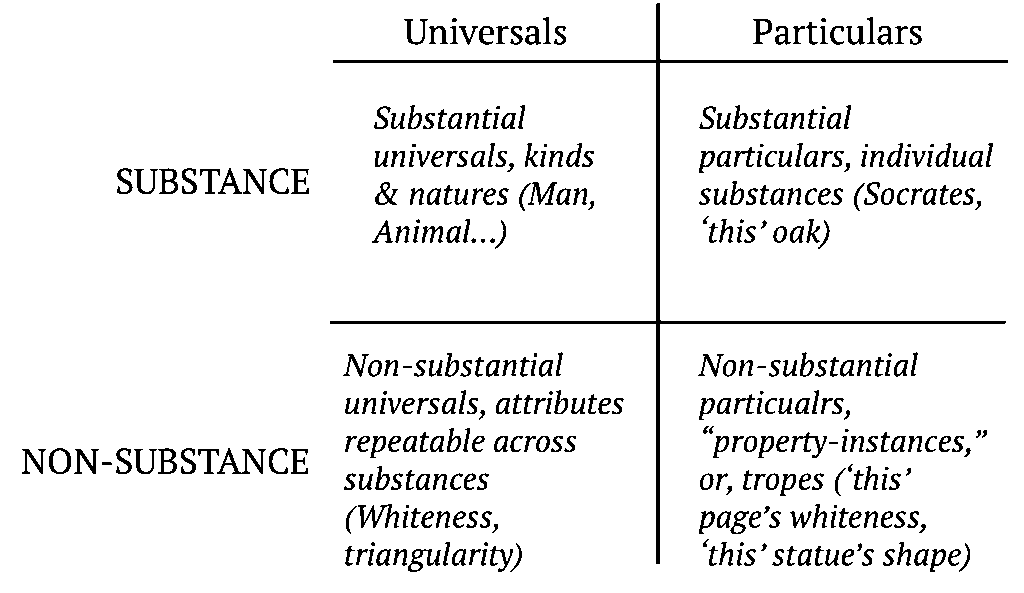
I will now provide a simple overview of Lowe’s four-category ontology, repeating information for clarity. First, Lowe’s ontology is constructed by combining the two fundamental contrasts of substance v. non-substance and universal v. particular. By crossing these contrasts, Lowe produces four basic and irreducible categories of being: substantial particulars, substantial universals, non-substantial universals, and non-substantial particulars. The ontology is designed to be both exhaustive, in that every “thing” or entity must fall into one of these four categories, and non-reductive, in that no category can be explained away in terms of another.
Further, Lowe asserts that this avoids the ad hoc expansions or reductions that rival ontologies rely upon. For example, trope theories that must multiply tropes to capture universality, or substance-only accounts that struggle to accommodate properties. So, Lowe forms his four categories as:
i) Substantial particulars are individual substances such as Socrates, Bucephalus, or this oak tree. They are the independent existents in Lowe’s ontology: they do not inhere in anything else, nor are they predicated of anything else. They are the fundamental bearers of properties, as Lowe’s ontology is neo-Aristotelian in how he treats this category as ontologically basic: without individual substances, the substantial particulars, there would be nothing for “kinds” to be instantiated in, or for properties to inhere in. Substantial particulars, then, can be understood as the termini of dependence.
ii) Substantial universals are kinds or essences. For instance, “man,” “horse,” or “tree.” They are not reducible to sets of particulars or linguistic predicates; they are real universals instantiated by individual substances. The role of substantial universals is explanatory, in that they answer the question “what is it?” about a certain particular. To put this into example, Socrates is this particular human being (substantial particular) but he is also an instance of the kind Man (substantial universal). Importantly, like I said earlier, substantial universals depend on particulars for their instantiation. There cannot be a kind with no instances. Yet, particulars also depend on universals to determine their identities as the kinds of things they are, forming an almost synoptic link.
iii) Non-substantial universals are attributes that can be shared across many particulars, such as “whiteness,” “triangularity,” or “courage.” These are not kinds of substances. They are repeatable features, irreducible to their instances. For Lowe, the necessity of these universals is in explaining predication as, for instance, when we say, “Socrates is white,” we are not simply pointing to a bundle of tropes but appealing to a repeatable feature, the universal whiteness, that can be exemplified in many other substantial particulars.
iv) Non-substantial particulars are property-instances and are also often called tropes. Some examples would include “this whiteness of this page,” or “this courage in this soldier at this time.” Unlike the non-substantial universals, they are not repeatable; unlike substances, they are not independent existents. Non-substantial particulars depend doubly, in first the substance in which they inhere, and on the universal they exemplify: a page’s whiteness cannot exist without the substance of a page nor without the non-substantial universal of whiteness. These things secure the connection between particularity and universality within properties, making Lowe’s ontology symmetric.
In this cross-schema diagram I made, you can observe the four categories in a (hopefully) simple but coherent way.
The four-category ontology itself is held together by what Lowe calls ontological relations. These relations are structured forms of dependence between categories, and they are what give the ontology explanatory power. Ontological relations, in essence, “map” how the categories connect to one another. So, Lowe distinguishes between three such relations:
i) Instantiation: a relation between substantial particulars and substantial universals. For example, Socrates (substantial particular) instantiates the kind Man (substantial universal).
ii) Exemplification: a relation between non-substantial particulars and non-substantial universals. The whiteness of this page (non-substantial particular) exemplifies the universal “whiteness” (non-substantial universal).
iii) Inherence: a relation between non-substantial particulars and substantial particulars. The whiteness of this page (non-substantial particular) inheres in the page itself (substantial particular).
All of these relations are what I would call asymmetric and dependence-structuring. A substantial universal such as Man cannot exist without being instantiated by some substantial particular, but Socrates himself, as a substantial particular, does not depend on any one universal for his existence. Likewise, a property-instance like the whiteness of this page cannot exist without, as mentioned, both the substance in which it inheres and the universal it exemplifies.
Thus, we now have a comprehensive yet simple introduction into Lowe’s meta-ontological work, The Four-Category Ontology! I would say to note that Lowe’s ontology is not simply a “classificatory scheme,” if such a thing could be said, but a structured account of how the most basic kinds of entity are related to one another. This article is simply an introduction, so the issues or reluctancy that certain metaphysicians, or people in general, have in Lowe’s invocation of universals (as they have become a point of great hesitancy in contemporary philosophy) will be discussed at a later time.
References
- Aristotle. Categories. In The Complete Works of Aristotle: The Revised Oxford Translation, ed. Jonathan Barnes. Princeton: Princeton University Press, 1984.
- Lowe, E. J. The Four-Category Ontology: A Metaphysical Foundation for Natural Science. Oxford: Clarendon Press, 2006.
- Lowe, E. J. More Kinds of Being: A Further Study of Individuation, Identity, and the Logic of Sortal Terms. Oxford: Wiley-Blackwell, 2009.
Footnotes
- Bekker references: 1a1–1a16 (homonymous, synonymous, paronymous); 1a20–2a4 (said-of/in-a-subject distinction); 2a11–19 (primary and secondary substances); 2a33–2b6 (accidents in a subject); 2b6–2b19 (priority of substance); 1b25–2a10 (list of categories beyond substance). ↩︎